

The Joy of Missing Out
When you retire, something strange happens. Your calendar looks wide open, and suddenly, everyone wants a piece of it.
At first, it feels flattering—your time is in demand. But if you don’t learn to say no with intention, your well-earned freedom can quickly vanish under a pile of coffee dates, volunteer commitments, and favors that weren’t part of your retirement dream. Without meaning to, you may find yourself working just as hard as before, only this time without a paycheck.
That’s the paradox of retirement. An open calendar that promises peace can become a trap if you don’t guard it with boundaries. Saying no becomes a critical skill, not because you’re selfish but because you’re protecting the life you’ve spent decades working toward.
Still, for many of us, saying no doesn’t come easy. It feels uncomfortable. Unnatural. Even risky. Why is that?
Why Saying No Gives You the Ick
Long before emails, deadlines, and family group chats, we were kids trying to stay safe in a grown-up world. For many of us, the earliest lesson was simple: Acceptance equals survival.
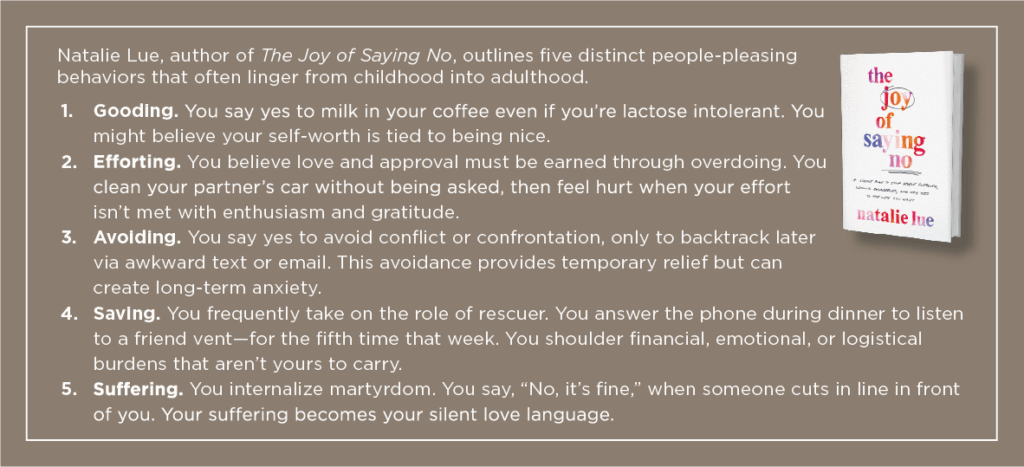
“Saying no in childhood often triggered disappointment, anger, or withdrawal,” says Natalie Lue in her book, The Joy of Saying No. It’s a cautionary tale about why constant people-pleasing not only is a detriment to joy but can also harm your health. “We learned to equate no with rejection. This early wiring makes it hard to distinguish a simple boundary from an emotional risk.”
As we grow up, what we say no to is often either family or work. A parent may feel like a failure when they miss a child’s basketball game to prioritize a work project. Someone may feel like they’re disappointing their partner when they need to visit an aging parent on a regular date night.
In both examples, the person saying no feels guilt and regret. Coupled with the subconscious childhood fear of rejection, these adult experiences can make saying no feel like an insurmountable challenge to be avoided at all costs.
The result is that we say yes too often and overcommit ourselves to what other people want from us. It’s a lose-lose situation. Both paths lead to stress.
The Cost of Cortisol
When our cave-dwelling ancestors faced life-threatening danger—an unknown sound or sight nearby—their brains sent a distress signal to their adrenal glands, which released cortisol, the stress hormone. Cortisol, in turn, signaled their body to release glucose, a fuel that could power either fight or flight. This mechanism evolved to help humans succeed in a dangerous world.
While most of us are no longer on high alert to threats in the brush, our bodies, brains, and nervous systems have not evolved at the same pace.
The human body today reacts the same way to an overly full calendar as our ancestors’ bodies reacted to a lion. Cortisol erupts, but rather than pushing a person to fight or flee, it triggers inflammation, weight gain, insomnia, depression, memory loss, and an increased risk of heart disease.
Lourdes Aldanondo, a therapist, naturopath, and co-author of the best-selling Ignite Your Life for Women, says many people think people-pleasing is just a personality quirk. But it’s also a cultural phenomenon and a chronic stressor with real effects on physical and mental health.
Persistently elevated cortisol levels wreak havoc on the body. “If you never say no, your body lives in a state of subtle stress,” says Aldanondo. “Depending on your individual body’s vulnerabilities, you may develop irritable bowel syndrome, or if you’re a regular athlete, your muscles may tighten, leading to spasm and injury. If you’ve always been prone to headaches, stress can turn into a three-day migraine.”
“Each person’s body reacts to stress differently, but the common cause is the same,” says Aldanondo. “If you do not get a handle on the stress in your life, it’s a matter of when—not if—you will become ill.”
And the impact extends beyond stress. It also affects how we shape our daily lives, especially in retirement.
Retirement Brings Expectations
Life in retirement is fundamentally different from life with a career. The shift from structured workdays to an open calendar creates a false impression you are constantly available. You have the chance to control your days and weeks—in theory at least. It’s important to recognize this opportunity and seize it.
“Perhaps the most important thing to learn is that free time doesn’t equal availability,” says Lue. Without clear boundaries, your well-earned freedom can quickly morph into everyone else’s convenience.
“Boundaries are the walls that protect your freedom,” says Aldanondo. “They’re not rigid; they’re flexible, but firm. When you listen to your body, especially your gut, your life becomes much easier.”
In retirement, saying no is essential. Imagine your boundaries not as a fence to keep others out, but as a frame that can help hold your life in place.
Calendar with Intention
One person taking charge of retirement is former CAPTRUST Chief Marketing Officer John Curry, who stepped back from a busy career last year and moved to Barcelona.
“As a working person, your day starts out full,” says Curry. “Within that fullness, you create capacity to do the things you love, like innovation or spending time with your team. You’re starting at the top and working down.” But that changes when you retire.
“In retirement, you’re building from the ground up,” he says. “You don’t have to do anything. So the question becomes, what do you want to do? How do you build the day or the week that you want?”
For Curry, that means scheduling daily Spanish-language study time, date nights with his wife, Marcela, regular time with friends, gym sessions, and rehearsals with his band. He jokes that this approach to scheduling feels a lot like playing Tetris.
“Each day begins as an empty board,” says Curry. “I stack time blocks—morning Spanish, evening rehearsals—so the pieces fit without pressure. When it works, I get to do things I enjoy without feeling overburdened or stressed.”
Curry says he has created a weekly structure that honors his passions, while also saying no to things that don’t align with his values or goals.
King of Your Castle
As in all things, balance is key. People will take as much as you give them.
Maybe you have a friend who always wants to meet up for dinner. Or you volunteer for an organization that is always asking for more. Thinking strategically about your calendar helps you avoid the pitfalls of saying yes when you want to say no.
You can’t build a fulfilling day or week—one that includes the joys of a well-lived life—without strong boundaries.
“If I know I’m going to be writing this week, how do I make sure I have the focus time I need?” says Curry. “I know I have music rehearsals on Wednesdays and Saturdays, so how do I defend my free time those days?”
Another good metaphor is to think of your boundaries as a moat around a castle. You hold the rope that raises or lowers the drawbridge. As the monarch, you’re responsible for protecting everyone inside.
“I know when I get overburdened,” says Curry. “I may commit to a music project or I know someone’s coming to visit me, and so I won’t be able to do some of my regular things. When that happens, I have to call a timeout and figure out what I can do to pare it back.”
Lower the drawbridge for the things you want in your life, but remember, saying no can protect your freedom.
Making It a Habit
If you struggle to say no and often find yourself overcommitted, don’t worry—you are not alone. Establishing boundaries isn’t easy, especially if you’ve never done it—or have done it poorly. But like any new habit, it gets easier with practice.
Here’s how to get started.
- Press pause. It’s easy to fall back into old patterns. A friend or relative asks you to do something you’ve done dozens of times already. Instead of saying yes automatically, call a mental timeout to really consider the request and remind yourself you hold the rope to the drawbridge.
- Don’t say sorry. If you decide to say no, you do not need to apologize. A simple “I appreciate the offer, but I have to pass” is enough. No further explanation required.
- Expect pushback. Be prepared for resistance. You might hear, “What do you mean? You’re retired. You’ve got all the time in the world!” Maybe that’s true, but it’s your time, and only you get to decide how you will spend it.
- Hold steady. If you give in, you teach others that you’re open to negotiating. But if you hold steady, you teach them to respect your boundaries. The more often you do this, the less likely it is that you will get pushback.
The key to success is knowing when to lower the drawbridge and when to keep it raised. Finding that balance is essential, especially during retirement, which should be your chance to control your calendar.
“There’s a common myth that boundaries are burdensome, but a well-placed no creates space for a truly joyful yes,” says Aldanondo. “Yes should be a buoy, not a boulder. It should lift you up, not sink you. When you choose the yes that lights you up, you show up better for your family, your work, and yourself.”
Written by Catherine Stuckey
Have questions? Need help? Call the CAPTRUST at Work Desk at 800.967.9948, or schedule an appointment with a retirement counselor today.