

Bonnie Baskin & The Science of Reinvention
As a child growing up in Chicago, Bonnie Baskin, PhD, was curious and independent. When she read Silent Spring, Rachel Carson’s groundbreaking warning about the unintended consequences of pesticides, she saw that science could shape the future.
She enrolled at the University of Miami to study marine biology. After a bout of seasickness on an early field trip, she changed course to microbiology.
It was a tremendous time to enter the field. Microbiology was evolving from simply observing organisms through a microscope to decoding the mechanisms of life itself. Baskin committed herself fully to the discipline.
“I got a PhD, and then I wound up getting a postdoctoral fellowship,” says Baskin. “Then I was in Bethesda at the National Institutes of Health for a couple of years.” By the early 1980s, she was working in a virology research lab in Minneapolis at the University of Minnesota.
The work was rigorous and rewarding, but still, something was missing.
Wanting More
In 1982, Baskin sensed an opportunity when the Food and Drug Administration approved the first antiviral drug against herpes simplex.
She did what due diligence she could on her own as the new field of antiviral drug development flourished. Unlike antibiotics, which kill bacteria, antiviral drugs treat viral infections by interfering with a virus’s ability to reproduce or function within the body.
Baskin canvassed Minneapolis-area pathologists to assess the market need and create awareness for a clinical virology testing service. Their feedback gave her the confidence to proceed.
“I wanted to do something,” says Baskin. “I didn’t know the word entrepreneurial at the time, but I guess that fits? I hired two wonderful virologists—way better than me—and decided to open a private diagnostic virology lab.”
The first home of ViroMed Laboratories was an 800-square-foot lab in the basement of an office park near her home. Later, she bought a van and turned it into a mobile lab to handle time-sensitive tests quickly. She recalls possibly being the first to recognize and act on this opportunity.
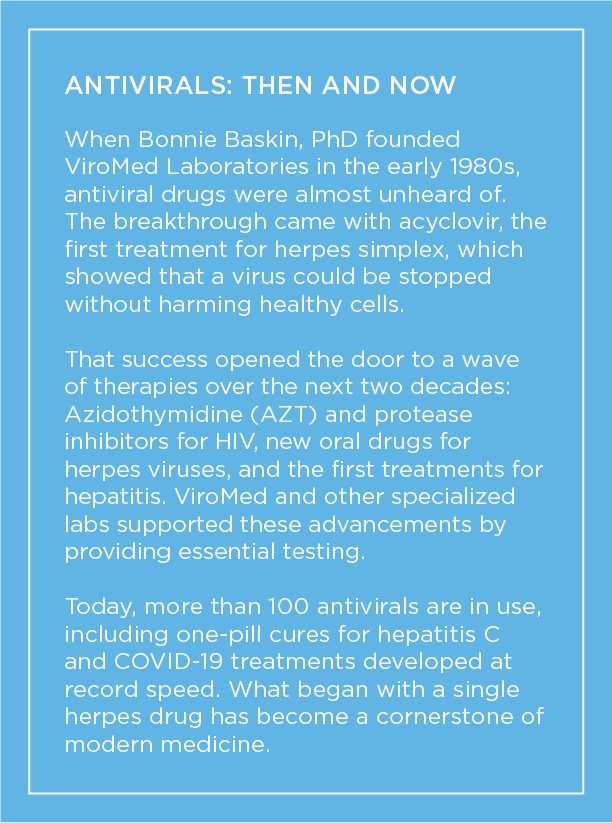
Baskin’s instincts proved correct. As the fields of antiviral drugs and testing technology grew, so did ViroMed. The company won major contracts and a reputation for quality and quick turnaround thanks to her focus on rigorous process and operational excellence.
Baskin is humble about her achievements: “Much of what I do is intuitive. I mean, I never took a business course or anything like that,” she says. “I just assume everybody else can do what I do.”
One milestone came when the company secured a global contract to perform AIDS testing for the U.S. Navy, a development that tested her resilience and persistence.
Baskin’s long hours and determination paid off in 2001 when the company caught the eye of Laboratory Corporation of America (LabCorp), one of the world’s largest clinical laboratory networks. She sold ViroMed’s clinical testing business to LabCorp to add to its infectious disease business and spun off the rest of the company to form AppTec Laboratory Services (AppTec).
Building on Success
Unlike ViroMed, AppTec was not a from-scratch start-up. Baskin had been nurturing the contract research and testing organization within ViroMed that served medical device makers and biologics developers.
“I had made some acquisitions at ViroMed,” says Baskin. “I looked at what our portfolio of expertise was, and I said, ‘You know, there must be other industries that could use our strong expertise.’” Once again, her intuition was right.
The medical device industry was evolving rapidly, driven by an aging population, chronic diseases, and advances in minimally invasive procedures. Increasingly, companies outsourced device testing to specialized contract labs, like AppTec, rather than building in-house capacity.
She also expanded into biologics, which proved to be another big opportunity for AppTec. Biologics are medicines derived from living sources—such as cells, proteins, genes, or tissues—and are used to treat diseases like cancer, autoimmune disorders, and diabetes.
With the support of venture capital partners, Baskin grew AppTec into a testing powerhouse with nearly 500 employees and facilities in St. Paul, Philadelphia, and Atlanta. In 2008, WuXi PharmaTech acquired the company, expanding its U.S. presence and biologics expertise.
Success to Significance
“I’m not recommending this for everybody, but for me, there was never any great long-term plan,” says Baskin. “If you’re going down the path and you don’t open your eyes to other things that may be available because you made your choice, you’re going to miss a lot.”
During her time in Minneapolis, the CEO of the Minneapolis YMCA approached Baskin about a board position. She was interested but cautious. “I said, well, the only way I’m going to be on the board is if I can have a project,” she says. “I don’t want to work on somebody else’s project.”
She developed a pilot program to help a cohort of first-generation college students at the University of Minnesota succeed. The program involved mentoring 35 students, not so much in academics but on what it’s like to be in college.
“Because they had nobody in their family or friend group that had ever gone to higher education, and they didn’t know what to do,” says Baskin. “They were thrown into a big university without the support that they needed.”
It was a success. Ninety-five percent of the students in the pilot program graduated in five years, confirming her belief that smart, talented students can excel with the right resources.
The amazing triumph of this project gave her the confidence that you can make a difference in the lives of students through high- impact programs.
Eureka Moment
In 2010, Baskin and her husband, Robert P. Elde, PhD, a science educator and former dean of the University of Minnesota’s College of Biological Sciences, retired and relocated to Johnson City, Texas—about midway between Austin and San Antonio.
“We got tired of the snow and the cold,” says Baskin. “It was going to be our winter place, and then we’d go back to Minnesota for the rest of the year.”
One day, as she was about to step into the shower, her phone rang. A friend called to tell her the old feed mill in the middle of town was for sale. The friend suggested that perhaps she could turn it into a bar or an art gallery.
The mill was built in the 1880s by President Lyndon Johnson’s great uncle, James Polk Johnson. It started as a steam grist mill but was later converted to electricity and became a feed mill. It ceased operations in the 1980s and turned into a restaurant and entertainment complex for several years before lying largely dormant.
Throughout its life, the mill significantly impacted the town’s economic life and served as a community landmark. “It was so cool and had great bones and these big silos,” says Baskin.
“At that point in my life, I was not going to open a bar,” she says. “That was just not in the cards. I went to the shower and started thinking about it. Then I said, ‘Wouldn’t it be a cool thing to be able to create a science museum for kids of this area who really don’t have a lot of access?’”
Baskin’s Vision
As usual, Baskin did her due diligence. Because of Johnson City’s strategic location between Austin and San Antonio, her proposed museum could attract school field trips from both cities as well as nearby rural communities without anything like her vision.
She knew funding would likely be hard to source because of her focus on middle school kids—but she believed they could make it work.
In fall 2012, Baskin and Elde bought the historic mill and began renovation to create the Science Mill. The restoration preserved much of the building’s original structure. They repurposed the grain storage silos as exhibit spaces that offer unique, immersive experiences. Walkways now connect the property’s original structures, allowing smooth visitor flow while retaining their original character.
According to the Science Mill’s website, “The design was conceived not as a contrast between new and old, but as the dynamic evolution of the mill from a place of industrial production to a place that can produce science leaders for the new generation.”
“When we grew up, there was no greater aspiration than to be a scientist,” says Baskin. “So much was happening at that time. It was exciting. But now it isn’t the same.”
Baskin and Elde worked together to shape the museum’s exhibit mix, from interactive technology and robotics to immersive biology. Elde personally designed the on-site biology lab where students can explore living systems firsthand.
Hands-On Experience
The Science Mill opened to the public in early 2015. Its mission is clear: to inspire and engage students in science, technology, engineering, and math (STEM), especially those from rural and underserved communities who might not otherwise have access to hands-on learning.
“You can’t fall in love with science by reading about it,” says Baskin. “You have to do it.”
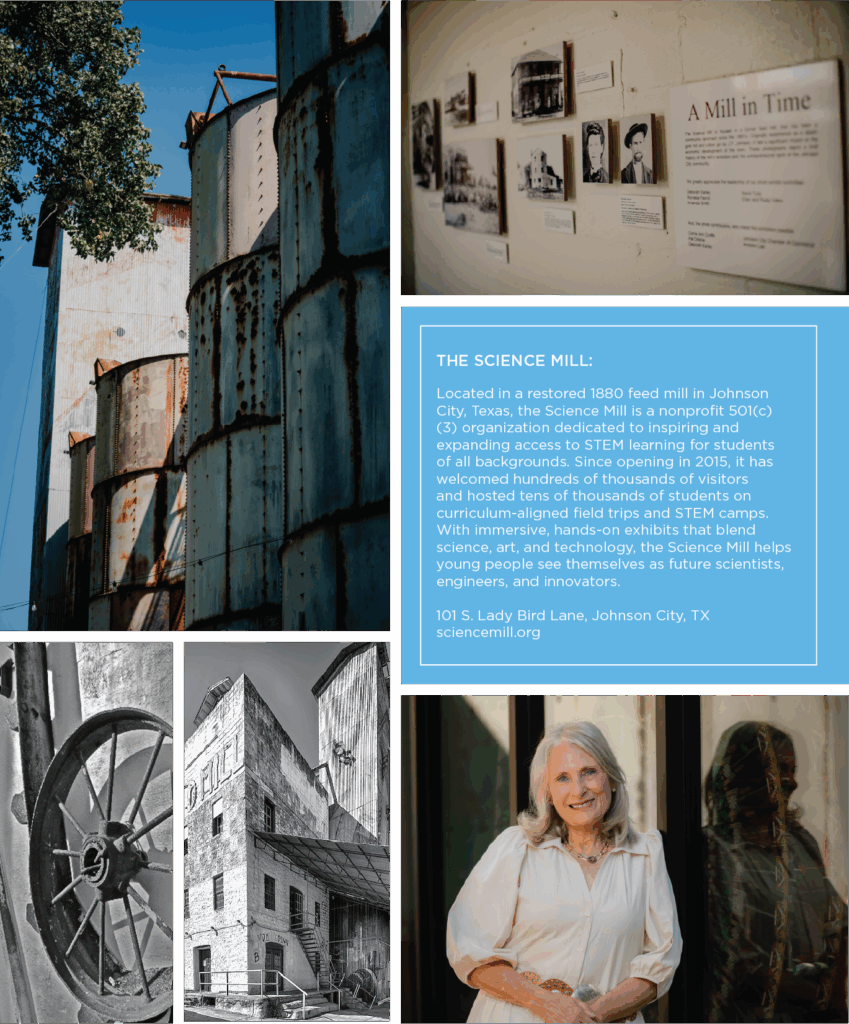
Baskin describes the museum’s purpose as helping kids see themselves in science. Rather than presenting abstract concepts in books, the Science Mill invites students to do science—tinkering, experimenting, and problem—solving in ways that connect to real-world careers.
Inside the Mill, students encounter exhibits that blend science, technology, and art through play and discovery. A few current exhibits include the following:
In one silo, the Light Loom transforms hand motions into shifting waves of color and light.
Another silo houses the Cell Phone Disco, where invisible electromagnetic waves from cell phones trigger dazzling bursts of light.
In the main gallery, students can use the Virtual Body Table to explore three-dimensional scans of human and animal anatomy.
Each installation is designed to spark curiosity by inviting exploration without step-by-step instructions.
Making a Mark
Over the past 10 years, the Science Mill in Johnson City has welcomed more than 400,000 visitors, including more than 91,000 students on school field trips. For many students, especially those from underserved areas, the Mill isn’t just a destination; it’s a bridge. It subsidizes admission and transportation, delivers hands-on STEM programs into classrooms, and offers field trips aligned with Texas curriculum standards.
The Science Mill has also grown beyond the walls of the historic mill itself. For example, its STEM Career Immersion Camps have served more than 17,000 students from more than 50 school districts, with 55 percent of those camps held in rural communities and 100 percent of attendees participating at no cost.
Students who visit report greater confidence in STEM, heightened interest in STEM careers, and a stronger sense of belonging in science learning environments.
“I always tell people that I worked all my life and did a lot of stuff, but this was the hardest job I ever had,” says Baskin. “And it took everything I had learned through all those years of for-profit business. I used every single one of those skills that I had learned before on this little museum.”
For Baskin, the Science Mill is more than a project; it’s a calling.
“It’s not cool to be a scientist when you’re in middle school,” she says. “That’s when we lose our kids. That’s especially when we lose our girls.”
Her second act ensures that in Johnson City—and far beyond—science stays within reach, right when it matters most.
Have questions? Need help? Call the CAPTRUST at Work Desk at 800.967.9948, or schedule an appointment with a retirement counselor today.